


Source Bron: www.goldenbaynz.co.nz:
Hilary & John Mitchell
“It is difficult to date accurately the arrival of Maori in Golden Bay (or Mohua, to give the district its old Maori name) but is likely to have been from the earliest times. Some of the place names and legends of Golden Bay are ancient, and derive from the Hawaikian Polynesian roots of the ancestral Maori. Signs of Maori habitation can still be discerned on almost every headland and promontory through the Bay from Separation Point to Puponga and down the western coastline.” “Het is moeilijk om precies te bepalen wanneer de Maori arriveerden in Golden Bay (of Mohua, zoals de Maori het gebied noemden), maar het is waarschijnlijk al sinds het allereerste begin geweest. Sommige plaatsnamen en legendes zijn zeer oud en stammen af van de Hawaiki-Polynesische oosprong van de voorouderlijke Maori. Sporen van Maori bewoning kunnen nog steeds gevonden worden op bijna iedere hoogte van Seperation Point tot Puponga en verder langs de westelijke kustlijn.”
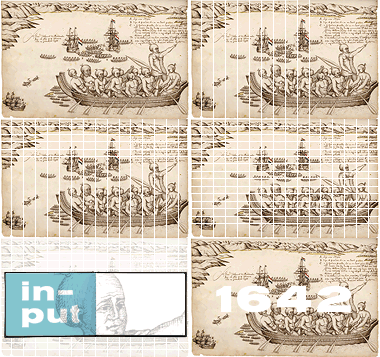
“It was at the hands of Tumatakokiri, the tribe which was in occupation at the time, that four of Abel Tasman’s men met their death. Several theories have been advanced to explain this tragedy – that Tasman’s men had unwittingly rowed into waters which were tapu (sacred) or had had a rahui (ban) placed on them; – that these strange white men in strange ships with strange ways (dress, muskets etc.) were taniwha who had to be chased away.” “Toen vier mannen van Abel Tasman destijds hun dood vonden, was het gebied in handen van de Tumatakokiri stam. Er zijn verschillende theorieën geopperd om deze tragedie te verklaren – dat Tasman’s mannen zonder het te weten in tapu (heilig) water verzeild waren geraakt of dat er een rahui (banvloek) op hen lag; – dat deze vreemde witte mensen in hun vreemde schepen met hun vreemde manieren (kleding, musketten, etc.) taniwha (watermonsters) waren, die weggejaagd moesten worden.”
“Unfortunately the eventual misfortunes of Tumatakokiri have blurred their history to the extent that we can only speculate about the possible participants in the events of 1642 and their reasons for them.” “Helaas is door het ongelukkige verloop van de geschiedenis van de Tumatakokiri niet meer te achterhalen wie er bij de gebeurtenissen van 1642 aanwezig waren of wat hun beweegredenen waren.”