
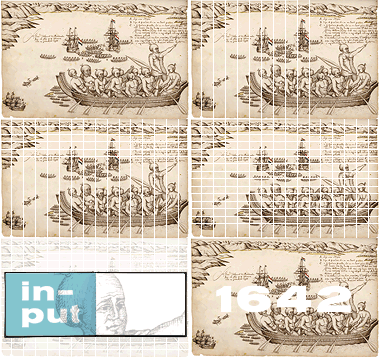


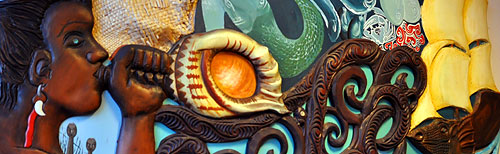
In November 2011, at the start of the project, when visiting the Abel Tasman Kabinet in Lutjegast, The Netherlands, we came across this artwork (click here). Five months later in Golden Bay, New Zealand, Robin Slow explained to us the origin of the work. Bij de start van het project in november 2011, toen we het Abel Tasman Kabinet in Lutjegast bezochten, zagen we dit kunstwerk (kijk hier). Vijf maanden later in Golden Bay, Nieuw Zeeland, kregen we van Robin Slow uitleg over de oorsprong van het werk.
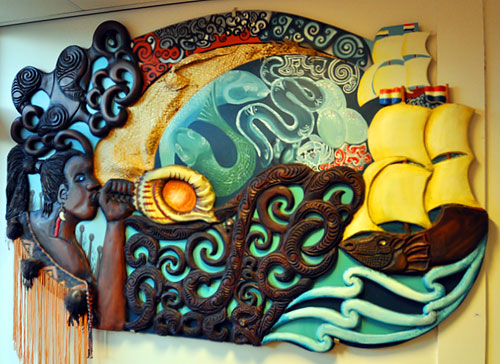
Robin Slow: “This was the original information that went with the mural giving an explanation of it.”
Above is the special name given to this piece of work made by children at the Onetahua Marae, Golden Bay, New Zealand, for the children of the Netherlands, to mark the occasion of Abel Tasman’s visit to the area in 1642.
The children used many of the traditional art forms, often in a ‘modern’ manner, to express what they understood about the event.
At the completion of the piece, the work was blessed, and from that point on became a ‘living’ piece of work.
The work can be ‘read’ with the following clarification and interpretation of symbols.
Starting at the top left hand corner is a large ‘manaia’ figure which represents the Maori people living in Mohua (Golden Bay) at the time of Tasman’s visit. There are five smaller maniaia head formations representing pa (village) sites. This leads on to the kowhaiwhai pattern designs that symbolise the fires lit along the beaches to signal Tasman’s arrival. The red for the flame and the black for the smoke. The blue represents the winds that blow in that area. The kowhaiwhai patterns were based on the opening up of the fern or koru which in itself symbolises new growth and new life.
Below the kowhaiwhai is the formation of Onetahuna (Farewell Spit) by the use of harakeke (a flax like plant). This was woven using traditional methods to create in a modern way the sand hills and the foam from the waves on the beaches. The fish show why the people were living in the area. It was a very important area for the catching of a wide variety of different fish. In the corner of the painting can be seen further red designs to stand for the blood shed on the conflict that took place.
Tasman’s ships sail on the blue waters of the bay. The lower ship has the head of a dragon to compliment the taniwha in the form of a waka (canoe). The taniwha could be interpreted as the Maori form of a dragon. It has been stated that in Tasman’s time it was a common belief that when sailing in unknown waters, sea monsters and dragons could be lurking there.
The warrior is calling on his shell. This was a signal for all the people to get inside the pallisades. It was also a signal for warfare. Tasman had replied with the trumpets, though not with the same meaning as the Maori people. A misinterpretation of signals with consequence.
The Maori warrior is wearing a cloak with a taniko boarder. This has been woven in the traditional manner. The pattern is from the Taranaki area where the present tangata whenua (people of the land) come from.
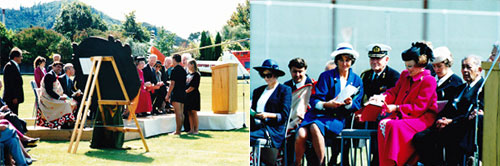
Robin Slow: “We held a number of hui (gatherings) at the Marae from 1991, for young people from throughout the region. These proved very successful and we were asked by the whanau to hold another one to create murals to commemorate the 350 anniversary of Tasman’s visit to the Bay. The hui was partly sponsored by the Nedloyd Shipping Company and had support from the Dutch Embassy at the time. It was my task at the time to organise the groups to work on the murals, and to see they were completed. We brought in some traditional carvers, had women weaving, and other completing stone and bone work. There was another person, Gavin Britt that helped all the way through. He is also a teacher and with the two of us we used the process of art making to empower students, to encourage them and for them to learn about some of the traditional approaches. It was a co-operative process. Eight murals were completed over five days with the students working all hours of the day and night to get them completed. The mural you have the photograph for was presented to Queen Beatrix on her visit. It was from the young people of the area to the young people of the Netherlands. I know the Queen presented it to a school in the town where Tasman lived and so it is interesting to see where the final resting place has been. The other murals went to the embassy, the Nedloyd ships and one stayed at the Marae. In many ways the work on the murals was part of the process to completing our own Marae in the manner it has.”
Photographs of the Queen’s visit and texts provided by Robin Slow. Foto’s van het bezoek van de Koningin en tekst aangeleverd door Robin Slow.